Synthetic Division Calculator
Divide any polynomial by x - c with full synthetic division steps: the table, quotient, remainder and a check. Handles missing terms and negative c.
Synthetic Division Calculator
Perform synthetic division to divide a polynomial by a linear divisor of the form (x - c). This calculator shows the complete step-by-step process, quotient, remainder, and verification.
Polynomial Input
Enter the coefficients of the polynomial in descending order of powers.
Example: For 2x³ + 5x² - 3x + 7, enter: 2, 5, -3, 7
Divisor
Enter the value of c for the divisor (x - c)
Example: For (x - 2), enter c = 2. For (x + 3), enter c = -3
Synthetic Division Calculator
Introduction
Synthetic division is a shortcut for dividing a polynomial by a linear factor of the form (x - c). It condenses the long division process into a compact table of coefficients. This method saves time and reduces errors, but it is not a replacement for understanding polynomial arithmetic. It works only for linear divisors with a leading coefficient of 1. When you use a synthetic division calculator, you are not skipping steps; you are using a method that is genuinely more efficient for the specific case of a divisor like (x - c). One indicates how to use it, what the numbers in the table mean, and when the method does not apply. By the end, you will know not just how to enter numbers, but why the result looks the way it does, and how to verify it without relying on a black box.
How to Enter Your Polynomial and Divisor
The synthetic division calculator asks for the polynomial and the value of c from the divisor (x - c). The polynomial input is flexible: you can type the coefficients in descending order of powers, like 2, 5, -3, 7 for 2x³ + 5x² - 3x + 7, or you can type the full polynomial expression, like 2*x^3 + 5*x^2 - 3*x + 7. The divisor must be of the form (x - c), and you enter the value of c, not the whole expression. This is where most errors happen. The calculator is literal: it takes the number you type and uses it directly in the synthetic division table. So read the problem, write down the divisor, and then set c equal to the opposite of the constant term. This one habit eliminates the majority of mistakes in synthetic division.
Missing terms are another trap. If your polynomial is x³ + 1, you must include the missing x² and x terms with coefficient 0. The calculator handles this if you enter the full polynomial, but if you enter coefficients, you must enter 1, 0, 0, 1. The calculator will not guess what you meant.
Reading the Synthetic Division Table
Once you click Perform Division, the calculator builds a table with three rows. The top row is the coefficient row: the coefficients of your polynomial in descending order of powers, including any zeros you entered. The middle row is the products row, where each number is the result of multiplying the value below it in the previous column by c. The bottom row is the results row, which starts with the leading coefficient brought down unchanged.
Here is how to read it. Add the second coefficient to that product, write the sum in the results row. Repeat: multiply that sum by c, add to the next coefficient, and so on. The last number in the results row is the remainder. The numbers before it are the coefficients of the quotient polynomial, in descending order of powers, starting one degree lower than the dividend. For example, dividing 2x³ + 5x² - 3x + 7 by (x - 2) gives a quotient of 2x² + 9x + 15 and a remainder of 37.
The table is not just decoration. If you are studying, this table is the fastest way to see exactly where a mistake happened. The calculator also offers display options: you can choose the number of decimal places, show the step-by-step process, show verification, and show the division table. Turning on the step-by-step process walks you through each column, one at a time, which is invaluable for learning the method.
What the Remainder Tells You: The Remainder Theorem
The remainder in synthetic division is not an afterthought; it is the most important number in the table. The Remainder Theorem states that the remainder when you divide a polynomial P(x) by (x - c) is exactly P(c), the value of the polynomial when you substitute x = c. This means you can evaluate a polynomial at a point without doing the full substitution, using only the coefficients and a few multiplications. This is not a coincidence or an approximation; it is exact. When the remainder is zero, the quotient polynomial times the divisor equals the original polynomial, so you have factored it completely in one step. This is why the synthetic division calculator is so useful for checking potential rational roots: test a candidate c, and if the remainder is zero, you have found a factor. If they match, the division is correct.
When Synthetic Division Does Not Apply
Synthetic division is a specialized tool with hard limits. The most important one: it only works for linear divisors of the form (x - c). If your divisor is a quadratic like (x² - 1) or a cubic, the synthetic division algorithm does not apply. You must use polynomial long division instead. The calculator will reject a divisor that is not linear, and for good reason: the table relies on the single coefficient of x in the divisor to drive the multiplication pattern. A quadratic divisor would require a different, more complex algorithm.
The second limitation involves non-monic divisors, that is, divisors of the form (ax - b) where a is not 1. For example, (2x - 3) is a linear binomial, but it is not of the form (x - c). If you do, the quotient will be off by a factor of a. The correct approach is to factor out the leading coefficient, divide by (x - c) where c = b/a, and then divide the resulting quotient by a. Some textbooks skip this step, but the standard convention is that synthetic division only accepts divisors of the form (x - c), so for (2x - 3), you must first rewrite it as 2(x - 3/2), divide by (x - 3/2), and then divide the quotient by 2. This is a common source of error, so double-check your divisor before entering it.
Finally, synthetic division assumes you have included all terms of the polynomial. If a term is missing, you must insert a zero coefficient. This is not optional; a polynomial like x³ + 1 has coefficients 1, 0, 0, 1, not 1, 1. The calculator will not fill in missing terms for you when you enter coefficients manually, though it will if you enter the full polynomial expression.
Synthetic Division vs. Polynomial Long Division
Synthetic division and polynomial long division both find the quotient and remainder when dividing polynomials, but they differ in scope and efficiency. Synthetic division requires a linear, monic divisor, meaning the coefficient of x is 1. Long division handles any divisor, including quadratics and higher-degree polynomials. The table below summarizes the key differences.
| Aspect | Synthetic Division | Polynomial Long Division |
|---|---|---|
| Divisor requirement | Linear and monic | Any polynomial, any degree |
| Notation | Coefficients only, compact table | Full polynomial terms written out |
| Steps for a cubic dividend | 5-7 operations | 3-4 times as many written steps |
| Error-prone areas | Sign of c, missing zero coefficients | Subtraction of like terms, aligning degrees |
| Best for | Quick division, evaluating P(c), factoring | Any divisor, including quadratic or higher |
| Remainder interpretation | Directly P(c) via Remainder Theorem | Remainder is P(c) too, but more work to find |
| Teaching value | Reveals structure of division | Shows full arithmetic |
Choose synthetic division when the divisor is (x - c). For any other divisor, use long division. The calculator automatically uses synthetic division for linear monic divisors, so you do not need to choose.
How to Do Synthetic Division Step by Step
Write the coefficients of the dividend in descending order of powers, placing a zero for any missing term. Bring down the leading coefficient to the bottom row. Multiply that number by c, and write the product under the second coefficient. Add the two numbers in that column, and write the sum below the line. Repeat: multiply the sum by c, write the product under the next coefficient, add, and continue until you reach the last coefficient. The final sum is the remainder, and the numbers before it are the coefficients of the quotient, starting with the term one degree lower than the dividend.
The synthetic division calculator automates this process, but understanding the steps helps you verify the output. For example, dividing 4x³ - 2x² + x + 5 by (x - 2): bring down 4, multiply by 2 to get 8, add to -2 to get 6, multiply 6 by 2 to get 12, add to 1 to get 13, multiply 13 by 2 to get 26, add to 5 to get 31. This matches the calculator's output, and it is the same result you would get from long division, but with less writing.
Synthetic Division for Higher-Degree Polynomials
Synthetic division is not limited to quadratics or cubics. It works for any degree polynomial, as long as the divisor is linear. For a quartic polynomial, you perform the same steps, but you have one more column of coefficients. The degree of the quotient is always one less than the degree of the dividend. Synthetic division is a powerful tool for higher-degree polynomials, where long division becomes tedious and error-prone.
The calculator supports polynomials up to degree 8, which covers most textbook problems. If you have a degree 9 or higher, you can still use the method, but you will need to enter the coefficients manually, and the table will be longer. The result of dividing P(x) by (x - c) is always of the form P(x) = (x - c)Q(x) + R, where Q(x) is the quotient and R is the remainder. If R is not zero, then (x - c) is not a factor, and c is not a root. If they do not match, something went wrong in the input. This is a valuable check, especially when you are working with large coefficients or missing terms. The interpretation section of the output tells you whether c is a root, whether (x - c) is a factor, and how to write the polynomial in factored form. This turns a simple division problem into a complete solution.
Synthetic Division Formula and Identity
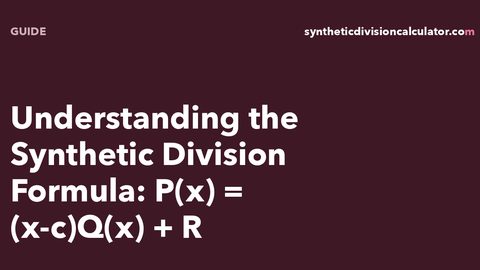
The underlying identity of synthetic division is P(x) = (x - c)Q(x) + R, where Q(x) is the quotient and R is the remainder. The formula works for any polynomial P(x) and any constant c. The value of R is always P(c), by the Remainder Theorem. Understanding this identity helps you use the calculator more effectively, because you can predict what the output should look like and catch errors if the numbers do not match the formula.
Common Mistakes and How to Avoid Them
A single sign error throws off every subsequent calculation. The most frequent mistake is entering the wrong sign for c. If the divisor is (x + 3), then c is -3, not 3. The calculator helps by allowing you to enter the full polynomial, which it parses to fill in the zeros.
Another error is dividing by a non-monic divisor without adjusting. The calculator does not allow this input, forcing you to use the correct method. These safeguards make the synthetic division calculator a reliable tool for both students and professionals.
Synthetic Division Calculator FAQ
What is the maximum polynomial degree the calculator supports?
The calculator supports polynomials up to degree 8. For degree 9 or higher, you must enter coefficients manually and the table will be longer.
Can I use synthetic division with a divisor like (2x - 3)?
No. Synthetic division only accepts divisors of the form (x - c). For (2x - 3), rewrite it as 2(x - 3/2), divide by (x - 3/2), then divide the quotient by 2.
What happens if I forget to include a missing term in the polynomial?
You must insert a zero coefficient for any missing term. For example, x³ + 1 must be entered as 1, 0, 0, 1. The calculator will not fill in missing terms when you enter coefficients manually.
How do I know if (x - c) is a factor of the polynomial?
If the remainder is zero, then (x - c) is a factor and c is a root. The output will tell you this directly in the interpretation section.
What is the relationship between the remainder and P(c)?
The remainder when dividing by (x - c) is exactly P(c), by the Remainder Theorem. This is exact, not an approximation, and lets you evaluate polynomials without full substitution.
Can I verify my division result without redoing the work?
Yes. Use the identity P(x) = (x - c)Q(x) + R. Substitute c into both sides; if they match, the division is correct. The calculator also offers a verification display option.